
Table Of Content
Brush Up Basics
Let z = (a + i b) be any complex number. The nth root of complex number z is given by z1/n where n → θ (i.e. set of rational numbers).
Steps to Convert
Step 1
Convert the given complex number, into polar form.


Step 2
Add 2kπ to the argument of the complex number converted into polar form.

Step 3
Raise index 1/n to the power of z to calculate the nth root of complex number.

Step 4
Apply De Moivre’s Theorem

Step 5
Obtain n distinct values. After applying Moivre’s Theorem in step (4) we obtain which has n distinct values. These values can be obtained by putting k = 0, 1, 2… n – 1 (i.e. one less than the number in the denominator of the given index in lowest form).
Therefore n roots of complex number for different values of k can be obtained as follows:

Example to clear it all
Find the cube root of iota i.e. (i1/3)
Let z = i (iota) and n = 3
Step 1
To convert iota into polar form, z can be expressed as
Z = 0 + 0.i
We need to calculate the value of amplitude r and argument θ. Now,

Step 2
Add 2kπ to the argument.

Step 3
Take cube root of both sides.

Step 4
Apply De Moivre’s Theorem

Step 5
Put k = 0, 1, and 2 to obtain three distinct values.

Thus, three values of cube root of iota (i) are

It is interesting to note that sum of all roots is zero.
Find the nth root of unity. (1)1/n, Explained here.
Observation to give you insight
(z)1/n has only n distinct values which can be found out by putting k = 0, 1, 2, ….. n-1, n.

When we put k = n, the value comes out to be identical with that corresponding to k = 0.
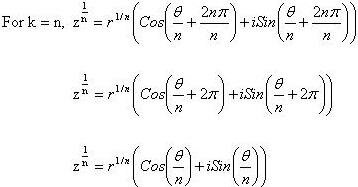
Which is same value corresponding to k = 0.
When we put k = n + 1, the value comes out to be identical with that corresponding to k = 1. Thus value of each root repeats cyclically when k exceeds n – 1. Hence (z)1/n have only n distinct values.